old country lawn

Monday, 7 April 2014

Spring 2014


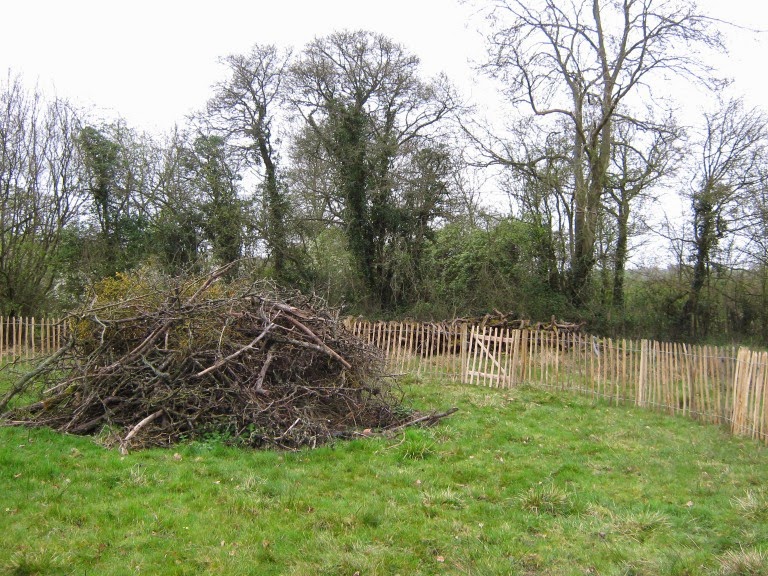
Its been a strange winter here on the farm - we spent much of the Autumn working on our large traditional apple trees, many of which needed urgent pruning, not only to deal with fallen branches and to improve their shape but to remove the enormous growths of Mistletoe which have taken over as the winters become warmer and wetter. Its even harder work than we remembered! involving straining one's eyes in the winter gloom to identify which branch to cut, stretching up as far as possible while balancing the telescopic saws, trying to stop the debris and sawdust going straight into your eyes, and avoiding the heavy growths as they crash to the ground! Then the gathering up and dragging to bonfire sites at suitable places in the orchards... The plan was to carry on after Xmas but the weather soon saw to that! So we only did about half the necessary work, and missed having the bonfires altogether. However, many birds (dunnock, blackbirds, robins) are very grateful, building early nests in the huge heaps of cuttings! So, no bonfires now until autumn.
The twisted, springy apple branches and fleshy mistletoe are not suitable for chipping - but fallen willows are, and we have laid down a good area of home-made chippings around the Studio as a thick mulch to suppress weeds and provide a nice floor for the picnic area.
Sadly we lost another huge old oak tree in the gales, as well as many older apple trees. Alot of tidying up and replanting to do!
The fence in the orchard behind the Lighthouse had to be replaced, and this time we opted for a cleft chestnut paling fence to divide the grazed orchard from a woodland edge, and were delighted to find it being made by coppice workers locally just outside Bromyard. It was no more expensive than anything I could find online, very strong, and should last a long while. Best of all, it is flexible and so looks beautiful in its setting. If you need nice home-grown and made fencing, look at Say It With Wood


Meanwhile dormouse and bat monitoring has continued through the winter and the Herefordshire Mammal Group is planning three special days here this summer, one of which is open to the public. If you'ld like to come along and learn more about the small mammals being studied here, and about how the scheme works, the date is August 9th, and it will be free, with refreshments. More details will be posted on this blog in due course. You'll also find details of upcoming walks in Botany, Insects, Woodpeckers and Bats!

Thursday, 1 August 2013


There was good attendance for Peter Garner's Wildlife Walk last month, when we ambled around the old sand pit and adjacent meadows, looking at the more unusual plants to be found on these sandier fields (most of the farm is heavy clay), before ending up in the farm kitchen for refreshments as usual. We found 'Townhall Clock' and also a large patch of Helleborines in the shady woodland in the old pit area. Many small toads (tiny, just developed from their tadpole phase) were observed, one tiny frog!, butterflies of course, although it was evening, and we heard a blackcap singing well. I am very grateful to Peter who has such a detailed knowledge of this area of the farm.


Since then it has been hot - I've been concerned about the trees and damper areas and was pleased to get some rain at last. A Spotted Flycatcher is nesting on my house and I am living peaceably alongside wasp and hornet nests. Just to observe the wasp nest being constructed and organised is awe-inspiring. Young birds are still turning up to the bird table for soaked bread (home-made!) and other left-overs, in particular Robins, Blue-tits, and Hedge-sparrows. A family of tawny owls regularly uses my bedroom balcony rail for their night-time parties and I heard a badger down below in the garden the other night. The wild areas in my garden are a huge success, with birds, bees and butterflies as well as amphibians and even a stoat making use of them. Each year they are cut back down in spring, to grow again such plants as thistle, dock, teazel, vetch, moon-daisy, convolvulus, willow-herb, wild rose, etc. We've added some feverfew, foxgloves and buddleia too. Its so easy! beautiful in flower, and rewarding to watch, even in the winter when the goldfinches and others feast on the seeds. The areas are about 15 foot across and surrounded by short grass which can be easily mown, and offset from each other so creatures can cross from one area to another in peace. I rather enjoy hiding in there myself!

Wednesday, 29 May 2013

Walking on the Wild Side

Good weather for last Sunday's Wild Plant Walk, (attended by a small but enthusiastic group), when Gerald Dawe discoursed expertly and amusingly on the habits and history of our wild plants. We found many plants which were indicators of ancient woodland, and of course the rare 'Goldilocks' and 'Town Hall Clock' and also 'Pignut'. Even an insignificant short grass or patch of moss is interesting when you look at it closely and consider its staggeringly long history. Since then the weather has remained cold and wet and this morning I was amazed by the sight of a Spotted Flycatcher on the bird table choking down the tit food! We have several pairs of these lovely little birds here this summer, haunting the old buildings and the orchards in their quest for insects. Clearly they are having a hard time this season. The apple blossom itself is very late, and a number of fruit trees look ill, I think the very wet winters have done them no good. Worse still, last week, in the gales, I heard a terrible rending sound and went outside to discover a huge oak tree, apparently healthy and in leaf, had wrenched itself out of the ground and lay across the farm track, fortunately damaging little and hurting nobody! Looking at the roots, we could see they had become rotten, and I speculate that might have happened from compaction around the roots as in the 50's and 60's heavy lorries passed along that track every day to and from the gravel pits. The trunk is huge, an awe-inspiring sight, and sorting it out will be an interesting exercise for Will!
The next Farm Walk will be led by Peter Garner, who has 'naturalised' in these parts for many years, and is entitled 'An Evening Nature Walk', on Thursday, July 4th, at 7pm, with refreshments at the end. I'm particularly looking forward to hearing what Peter has to say about the various habitats to be found here and their importance for certain species.

Monday, 13 May 2013

From Frogs to Flowers in a few short hops!

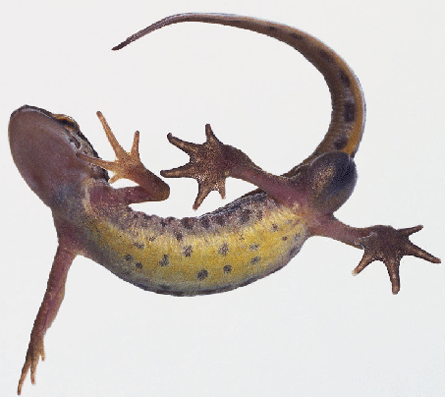
Nigel Hand's Pond Walk here attracted a good number of people, all keenly interested in how to make and manage ponds for wildlife. We took in three ponds of different types on the farm, some of which need to be given more light, or to have some of their sludge cleared out, so there's more vegetation for the newts. Nigel had kindly brought a good selection of creep-crawlies to aid identification. We also heard some Blackcaps singing well and a lesser-Spot Woodpecker drumming away.
Next event is on Sunday May 26th at 2.30 pm, when Gerald Dawe will lead a walk looking at the botany of the farm. Gerald, who lectures on the subject at Malvern Hills College has led a walk here last year and I know the walk will be both informative and amusing. Home-made cake and coffee/tea will be supplied.

Sunday, 3 March 2013

2013


Looking ahead to spring 2013, we have a walk planned on May 5th led by Nigel Hand, looking at reptiles and invertebrates.  Nigel, a true expert on the subject, has led a walk here before, and is Project Officer of the Herefordshire Nature Trust’s Ponds and Newts Heritage Network Project, which is holding a  Pond training day here at the farm  earlier this spring.  I am hoping the weather will warm up so we can see plenty of wriggly and slithery creatures! and enjoy learning about their habitats.  The walk starts here at the farm at 11am.

There will also be another botany walk this year led by Gerald Dawes, author and most entertaining lecturer at Malvern Hills College on local botany, to be held later in May.  Details to be announced.

Wednesday, 11 July 2012

Heavy rain, cold, and Wimbledon semi-final all conspired to make our bat event on 6th July a very small one!  However the barbeque was enjoyed and we were fortunate enough to hear and see lesser Horseshoe bats in the farm buildings, as well as Pipistrelles and others ( including possibly Serotine?) coasting about near the pond and over the tracks linking the buildings.  The following day I heard that 34 Bechstein bats had been counted by the woodland monitors, and  at the weekend, new guests to the B&B were thrilled to watch the spotted flycatchers bringing food to their nest, and, because it was so cold and I’d put out seed again, also saw woodpeckers, nuthatch and others on the feeders. Now we have yet more swarming  bees, who have decided to live under some eave tiles on the granary roof.  Numbers have appeared in the house, seeming confused and out of sorts, and I wonder if they have been affected by insecticide locally, as it has been proved to upset their homing sense (if it doesn’t kill them altogether).  How  I wish that people when buying their food and drinks would make the connection and insist on crops grown without these sprays – but perhaps our own intellectual faculties are similarly affected, or is it just laziness?

Further walks are planned, possibly another bat walk later in the summer when it is warmer (?), and in the winter we are looking forward to an interesting  and educational morning learning how to prune traditional orchard trees with a view to wildlife, landscape, and productivity, led by Janet Lomas.  I hope to then have the time over the winter months to apply these lessons, though there is plenty of other HLS work to do to hedges and ponds. The Higher Level Stewardship Scheme (HLS) is demanding and the weather can play havoc with our plans! We do our best. The new pond we made this spring is already full of ‘wiggly things’ and several hedges have been protected by new fence lines.  With the help of the AONB we have also planted hedge trees, oaks, and disease-resistant elms which will help maintain important features of the traditional landscape for future generations.